

Search Results

We Are Biodiversity
This article was included in our Summer 2019 issue of Manomet Magazine. In March 1932, despite conservation efforts, “Booming Ben,” the single surviving Heath Hen, a grouse-like bird, was seen for the last time on Martha’s Vineyard. A year later, Henry Beetle Hough posed a rhetorical question in the Vineyard Gazette ‘Is nothing to follow the extinction of this bird except one more lesson in conservation for school books, and a sentimental mourning?’ Indeed, the extinction of the Heath Hen was nothing more—another lesson for school books. Many such lessons have since followed, avian and otherwise. A species winks out. The earth rotates just the same, unencumbered by the loss. Every two years since 1998 The World Wildlife Fund publishes...
Meet ‘the Birdnerd’
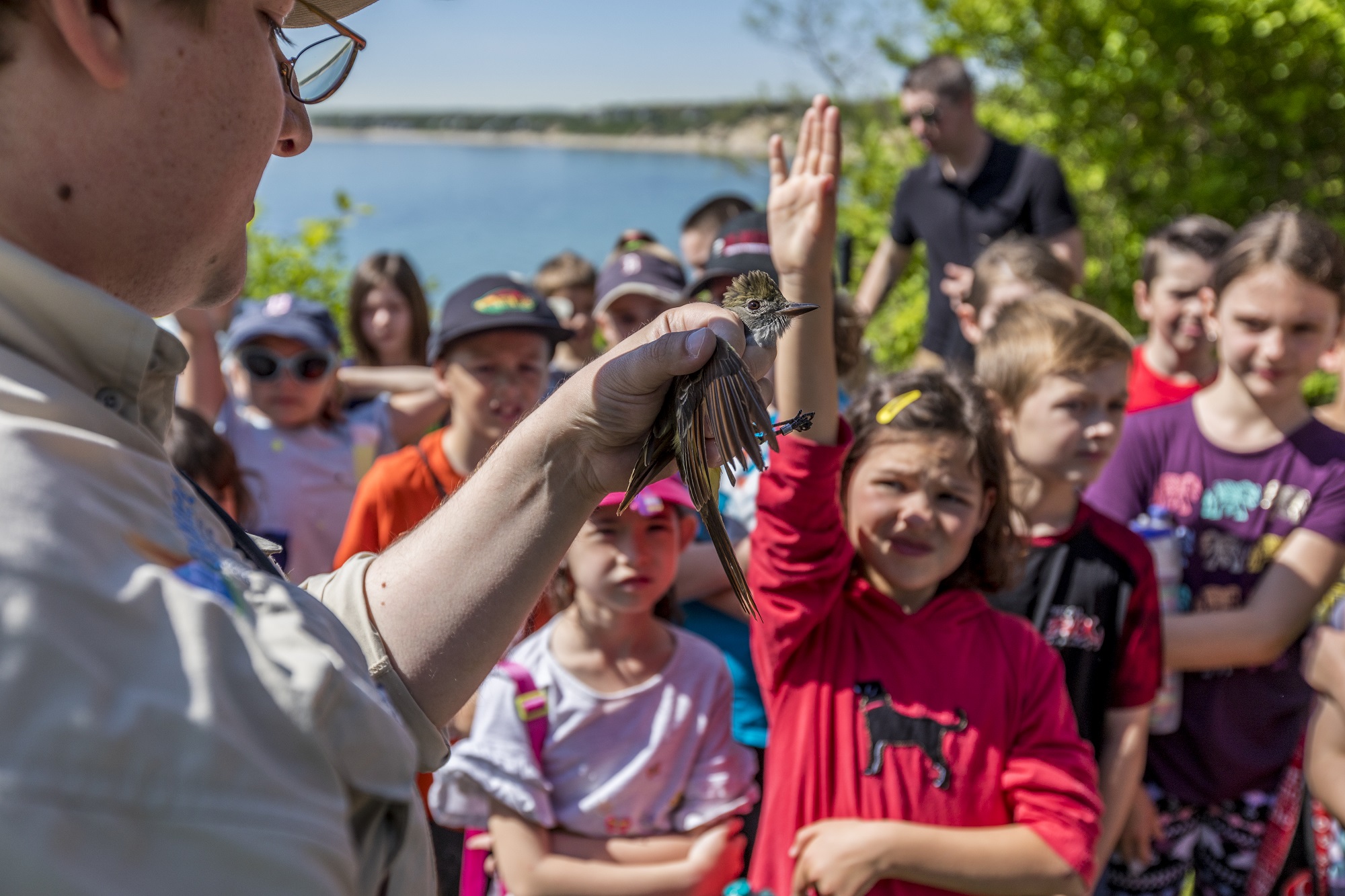
As part of our 50th Anniversary celebrations, we’ll be sharing interviews with Manomet’s current and past staff, former interns, and Board members. We’re kicking this off by catching up with Jason “the Birdnerd” St. Sauver, Director of Education & Outreach for Audubon Nebraska and a Manomet banding intern back in 2006-07. Jason recently was awarded the 2019 “Educator of the Year” by National Audubon Society. Looking back, Trevor Lloyd-Evans, Manomet’s Director of Landbird Conservation, recalls Jason as “a very charismatic teacher for groups when he was a banding intern here at Manomet” so he wasn’t surprised by this “very well-deserved recognition of Jason’s talent for teaching, innovation, and leadership.” “Manomet – and Trevor’s - impact on young banders/biologists cannot be...
August 2019 kicks off Manomet Inc.’s 50th year
50 years ago this August, Manomet Bird Observatory (MBO) in Plymouth, MA officially opened its doors on August 4, 1969. Now known as Manomet, Inc., Manomet’s work over its 50-year history expanded organically from the research and banding of landbirds to include projects on shorebird conservation, fisheries, forests, climate change, and working with the for-profit sector to create a more sustainable future. “Manomet is a science-driven sustainability organization. Our goal is for the next generation and the one after that to be able to thrive and support themselves sustainably, as well as to be able to enjoy the natural world like we have today,” says John Hagan, Manomet President. “The reason that we’ve been able to do what we do...
Building Bridges To The Future: Looking back from 1995–present day and making plans for Manomet’s next 50 years.
Materials (content and images) taken from the Manomet archives. Manomet’s work over its first 25 years expanded organically from landbirds, shorebirds, and forests and opened the door to a broader understanding of the world around us. This understanding of how the many facets of our world are connected—and a belief that we cannot solve the complex challenges that we are facing by ourselves—is integral to understanding our most recent past and how we are preparing to lead in our next half-century. When Manomet’s banding program celebrated its unofficial 30th anniversary in the fall of 1996, Linda Leddy, then President, shared in her cover letter of the spring 1997 issue of Conservation Sciences, that, “Bird populations are in trouble; the causes...
To Expand Beyond Banding: Looking back at the years 1969-1994 in Manomet’s history
Materials (content and photos) for this article were pulled from the Manomet archives. August 4, 1969, dawned in Plymouth, Massachusetts; warm and overcast and seemingly average. But excitement was in the air! Thanks to a driven board of directors, one full-time employee, nearly 450 members from 27 states, and a core group of volunteers, the newly formed Manomet Bird Observatory opened its doors on that first Monday in August—just in time for the first migrants to arrive for fall banding. “Manomet Bird Observatory has become a reality, the first of its kind on the Atlantic Coast of North America,” wrote Kathleen ‘Betty’ Anderson, Manomet’s first Executive Director, in the first-ever edition of the Manomet newsletter. “The value of the data...
Dragonflies and Damselflies
It’s late July, and the sun beats down. Birds and mammals retreat into the shade, waiting for the soothing cool of the evening. Meanwhile, an order of carnivorous aerialists peaks in abundance. As is the case every summer, a multitude of dragonflies and damselflies (members of the order Odonata) have emerged from their aquatic lairs to fill every corner of Manomet’s property. Ranging from high-fliers that patrol the skies to ambush predators that lie in wait in the undergrowth… they are everywhere. Odonate larvae (nymphs) live in the water, a life stage that can last several years. During this period, the nymphs pull water through their gills to capture oxygen, and their “exhale” helps propel them through the water. The...
Green Crab Week
Green Crab Week is a restaurant week taking place July 15-21 completely dedicated to the green crab harvest and soft-shell season. Sponsored by Manomet, Green Crab R&D, and New Hampshire Sea Grant, this week-long event celebrates an emerging fishery. Taste innovative green crab dishes at New England and NYC restaurants and learn how to identify and prepare green crabs. Meet green crab fishermen and scientists working to develop the nation’s first soft-shell green crab industry. Green Crab Week is the first of its kind and an opportunity to try a local and innovative delicacy applauded by the New York Times, Seattle Times, Boston Globe, and Guardian. Green Crabs Supplied By: NYC: Jamie Bassett and Greenpoint Fish & Lobster Massachusetts: Jamie...
Winged victory for shorebirds at Gould’s Inlet
“That’s a fish crow, flying in there,” said Abby Sterling, shorebird biologist with Manomet. “That’s one of the predators, so that’s one of the reasons these guys nest in such big groups like that, is so that they can all team up on them and drive them out. And so, last year (the colony) wasn’t successful at all because fish crows came in."
“Show me the purpose!” What the “Climate Change Generation” expects from businesses and prospective employers
This article was taken from the spring 2019 issue of Manomet Magazine. Chris Murphy is a Business Management major at the University of New Hampshire graduating this May. He is an athlete and has long known he wants to work in the sports industry after college; either at a professional firm (e.g., sports management) or for a pro sports team. Chris has spent four years pursuing a business degree to prepare him for this dream job, and has not taken a single environmental course while in college. His parents encouraged him to recycle growing up, but beyond that he knew very little about environmental sustainability. Since starting college, however, he has grown increasingly concerned about pollution and climate change, and...
Restoring sea run fish to the Gulf of Maine
On a recent sunny Saturday, a crowd of 300 people enjoyed the spectacle of alewives making their way up a tributary of the Bagaduce River to Pierce’s Pond in Penobscot, a community on the shores of Maine’s Penobscot Bay. Kids and adults alike marveled at the powerful instinct that drives the fish to work their way upstream, surmounting each rise against the flow of the stream as it tumbles down to the sea. Students from the local middle school waded in the stream for a close up look at the fish, listening as their teacher explained the life cycle of alewives, a sea run fish that lives in the ocean and spawns in freshwater. Ospreys and eagles circled overhead, keeping...