

Search Results

Manomet and partners collaborate to pinpoint reasons behind mysterious Semipalmated Sandpiper decline
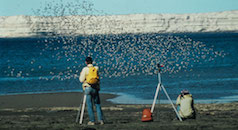
Geolocators used to identify migration routes and stopover sites in the life of each bird PLYMOUTH, MA April 5, 2017 – Understanding and managing migratory animal populations requires knowledge of all stages of their migration routes and their life cycle. Manomet, along with 18 partner organizations, embarked on the first large-scale analysis of migratory connectivity for Semipalmated Sandpipers among breeding, stopover, and nonbreeding sites. The results are contained in a new study published today by The Condor: Ornithological Applications. The Semipalmated Sandpiper (Calidris pusilla) is a small shorebird, most commonly seen on migration along the coastlines of the eastern United States. It was historically one of the most widespread and numerous shorebird species in the Western Hemisphere, breeding across the...
Solving Wicked Problems
By: Anne Hayden, Program Manager, Sustainable Economies Program Excerpted from the Fall/Winter 2016-17 edition of Manomet’s Partnerships for Sustainability magazine; read the complete article here. Many of the environmental problems we face today are so-called “wicked” problems, caused by a complex interplay of economic, ecological, and social factors. Consider the overharvesting of fish stocks: a decline in landings has the perverse effect of driving up prices; forage fish that once supported the marine food web are thwarted by dams that in some cases generate clean energy; and the ecological factors that control fish abundance defy simple assessment and management. Diverse constituencies are coming together to restore alewives, and aquatic keystone species Eastern Maine is suffering just such...
John Hagan: “From Soft-Shell Clams to Soft-Shell Crabs: Two Practical Solutions for Adapting to a Warming Gulf of Maine”
Originally posted at community.bowdoin.edu on February 16, 2017. Written by Rebecca Goldfine. Bowdoin College hosted two speakers this week who are exploring ways that Mainers who earn their livelihoods from the sea might respond to a warming ocean and changing marine ecosystem. The Gulf of Maine is heating up faster than 99 percent of the world’s oceans, and scientists foresee a time when historically lucrative fisheries—like lobstering and clamming—are gone, replaced with fish species unfamiliar to us. On Tuesday evening, field ecologist John Hagan spoke about his project to develop soft-shell clam farming in Maine. He was joined by Jonathan Taggart of Georgetown, Maine, who described his efforts to turn the invasive and problematic green crab into a sought-after food. (Originally invited speaker Marissa McMahan was not able...
“Mainstreaming” the conservation of shorebirds
By: Rob Clay, Director of the WHSRN Executive Office In December, countries attending the 13th United Nations Biodiversity Conference in Cancun, Mexico, reached agreements on actions to integrate biodiversity in forestry, fisheries, agriculture, and tourism sectors and to achieve the 2030 Agenda on Sustainable Development. 13th Conference of the Parties to the Convention on Biological Diversity (COP 13) Rob Clay, the Director of the WHSRN Executive Office co-led a side event at this conference (together with Matt Jeffery of National Audubon Society, and Scott Johnston of US Fish and Wildlife Service), also known as the 13th Conference of the Parties to the Convention on Biological Diversity (COP 13), focused on shorebird conservation. The side event highlighted the...
Interview with Manomet’s Monica Iglecia
Monica Iglecia Assistant Director, Shorebird Habitat Management Monica Iglecia is the Assistant Director, Shorebird Habitat Management, where the goal is to increase the capacity of both public and privately-owned wetlands to benefit shorebirds throughout North America. Manomet’s Habitat Management Division works with national wildlife refuge managers, state wildlife managers, farmers and private organizations to improve habitat for shorebirds. This interview is excerpted from the Fall/Winter 2016-17 edition of Manomet’s Partnerships for Sustainability magazine. To read the complete interview, click here. How did you become interested in Habitat Management? I’ve been interested in wildlife for as long as I can remember. I used to leaf through the pages of my grandparent’s National Geographic collection and be amazed and inspired by...
Climate change and coastal communities
By: Eric Walberg, Senior Program Leader, Climate Services Program Excerpted from the Nature-based infrastructure: The multiple benefits approach to coastal resiliency article in Manomet’s Partnerships for Sustainability FALL 2016/WINTER 2017 Magazine Climate change underscores the need for a green infrastructure-based approach to conservation planning. Coastlines around the world will be dramatically reshaped by sea level rise. Processes that have been set in motion by a warming planet, such as thermal expansion of sea water and melting of the Greenland and Antarctic ice sheets, will continue to unfold for centuries to come. In the immediate future, sea level rise will continue to exacerbate vulnerability to storm surge flooding by providing a higher launch point for coastal storms. The...
Protecting shorebirds in….Kansas?
How WSHRN built full lifecycle conservation for the Buff-breasted Sandpiper When most people think of shorebirds, they envision oceans and mudflats, not the plains and prairies of the American Midwest. But these areas provide a critical habitat for a large number of shorebirds. That’s why this recent news is so exciting: the Western Hemisphere Shorebird Reserve Network (WHSRN) Hemispheric Council voted unanimously to approve the nomination of the Flint Hills, a 3.7-million-acre (1.5-million-hectare) tallgrass prairie landscape spanning Kansas and Oklahoma, as a WHSRN Landscape of Hemispheric Importance. Manomet is a lead partner in WHSRN and implements program strategies and operations under the direction of the WHSRN Hemispheric Council. The Flint Hills represents North America’s last ecologically intact tallgrass prairie at...
Concord Art and Manomet collaborate for April Art Show
This spring Manomet will be collaborating with the Concord Center for Visual Arts—(Concord Art for short)—the second oldest art association in the country, for a special collaboration of science and art. From April 9–May 9 an art show titled BIRD: Metaphor + Muse curated by Holly Hanson. A new component of this particular show will be an additional student-curated art show called Solid Air: C-ART Exhibition where students will create works of art using data from Manomet’s Banding Lab. Through the sharing of talents and ideas, C-ART aims to facilitate meaningful connections among student artists, established artists, and art faculty, to develop collaborative exhibitions and art-making, and to enhance the arts programming at each institution while benefiting the broader Concord community. ...
Somebody should have begun the research years ago
One of the best marketing lines I ever heard came from none other than Manomet Bird Observatory (MBO) in 1987. The cover of the MBO brochure read, “To find answers to some of today’s tough conservation questions… somebody should have begun the research years ago.” I thought the next line was brilliant. It read simply: Somebody did.[1] Although a great marketing pitch for science, it was also a true statement. Too often we wish we had a valid reference point to measure how the natural world has changed. A recent story in the Alabama press reminded me of the genius of MBO’s pitch almost 30 years ago. The article reported that The National Fish and Wildlife Foundation, a multi-decade funder...
New Team Member for Development Department
Meet Steve Fulmer Manomet's new Director of Individual Giving (more…)