



 Back to all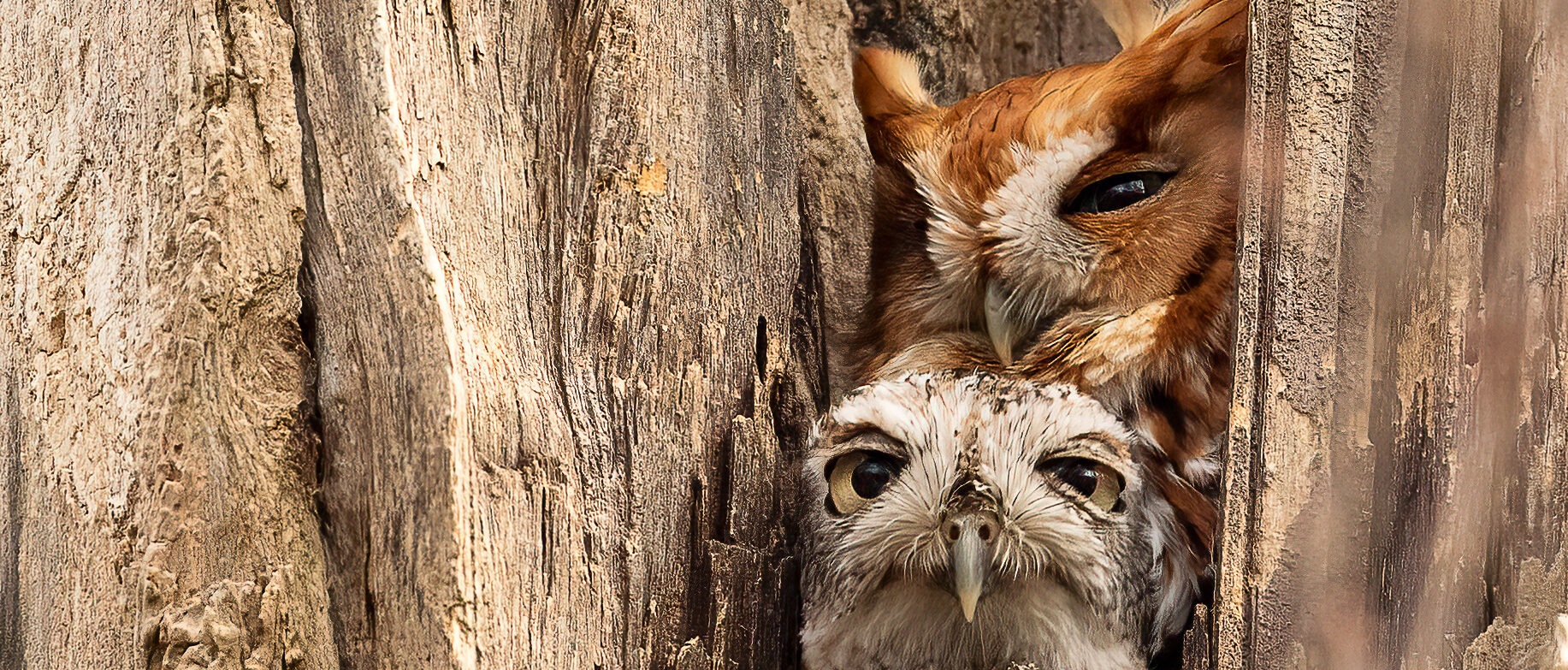
Some years feel steady. Others feel like the bird world is trying to get your attention.
In 2025, 203 species were documented on Manomet Conservation Sciences’ headquarters —and a handful of them stopped us in our tracks. This isn’t a list of the “most common” birds or the biggest counts. It’s a snapshot of the rare, unusual, and especially noteworthy sightings that made birders look twice: unexpected visitors, scarce migrants, and records that add a new line to Manomet’s long-running natural history.
To place each sighting in context, we compared observations across eBird, banding lab records, and decades of internal notes and journal entries. Because not every historic encounter was formally recorded, a “first record” here means the first time a species appears in Manomet’s official files. Sightings are listed in order of overall significance, based on how rarely a species has been documented at Manomet, whether it represents a first or limited site record, and how unusual it was for the season or region.
Screech-Owl pair (03/2025)

Eastern Screech-Owls are not uncommon at Manomet, but finding one roosting in the open along a walking path was very special. It became a bit of a celebrity among local birders and photographers. When photographer Linda Fuller shared photos revealing a second owl, we realized the original red-morph owl was no longer alone, with a sweet little gray-morph owl tucked beside it.
Evening Grosbeak at Manomet feeders (3/28/2025)

A female Evening Grosbeak spent only a day at our feeding station, where she entertained several visitors. This female represented one of the rarer birds to visit our feeders. We would like to thank Wild Birds Unlimited in Norwell, MA, for the feeding station!
American Oystercatcher 5th Record (05/09/2025)
While scanning Cape Cod Bay from the Manomet bluff, we detected two American Oystercatchers approaching from the south, alerted by their distinct calls. This species is a coastal breeder but is only occasionally recorded at Manomet, making this pair a noteworthy addition to the site’s long-term records.
https://ebird.org/checklist/S234930032
Pacific Loon 3rd record (10/11/2025)
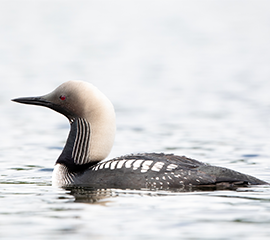
During the Big Sit on the bluff at Manomet’s Alumni Reunion, Alex Lamoreaux, a Manomet alumnus, spotted a breeding plumage Pacific Loon on the placid waters below.
https://ebird.org/checklist/S278767478
Olive-sided Flycatcher 10th record (05/19/2025)
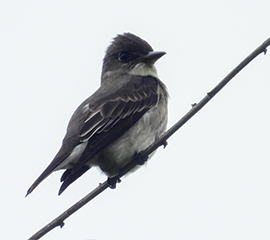
Following a big overnight migration that brought birds down into view, an Olive-sided Flycatcher appeared along the road below Manomet headquarters, briefly perching high in a treetop before disappearing. This species is an uncommon migrant in coastal Massachusetts, making it only the tenth time it has been recorded on the Manomet property, and the second without the help of a mist net.
https://ebird.org/checklist/S239302958
Nelson’s Sparrow (06/02/2025)
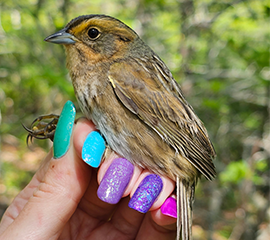
Before 1995, Nelson’s Sparrow and Saltmarsh Sparrow were treated as a single species in many records, so older sightings on the Manomet property may be grouped under “Sharp-tailed Sparrow.” Today, we can identify them as separate species, and it’s always a highlight to see these saltmarsh specialists up close in the banding lab.
https://ebird.org/checklist/S245974962
Seaside Sparrow 19th record (08/14/2025)
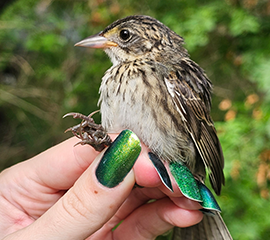
Seaside Sparrows are true saltmarsh birds; they spend their entire life in coastal marshes along the Atlantic coast. Because they depend so completely on this habitat, they’re especially vulnerable to marsh loss and sea-level rise, one reason Manomet’s coastal resilience work matters.
https://ebird.org/checklist/S267196540
Kentucky Warbler (04/30/2025)

After an active migration night, we found a Kentucky Warbler at Manomet. Instead of passing through, it stayed nearly 50 days and defended a territory—the only one of Manomet’s 11 spring records to do so—hinting at a possible northward range shift.
https://ebird.org/checklist/S231249761
Golden-winged × Blue-winged Warbler hybrid (09/20/2025)

During the South Shore Bird Club Fall Roundup, a warbler with unusual markings was spotted in the thicket above the viewing blind at Manomet. It initially disappeared before it could be confirmed, but was relocated the following morning, allowing photographs that revealed it to be a hybrid between a Golden-winged and Blue-winged Warbler.
https://ebird.org/checklist/S274442095
White-eyed Vireo breeding pair (05/02/2025)
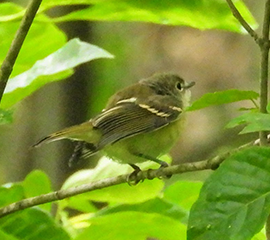
Historically, a common breeding species at Manomet, the range of the White-eyed Vireo has contracted southward in recent years. While records are still annual on the property, breeding records are now rare. Therefore, we were thrilled to have a confirmed breeding pair this year, frequently detected around the parking lot.
https://ebird.org/checklist/S231998228
Excited By These Sightings? Come Visit The Kathleen (Betty) Anderson Nature Trail, open daily at Manomet HQ! Either on your own or join our First Friday Bird Walks each month.
Full list of Manomet all-time species can be seen here:
https://ebird.org/hotspot/L207383?yr=all&m=&rank=hc&hs_sortBy=taxon_order&hs_o=asc