



 Back to all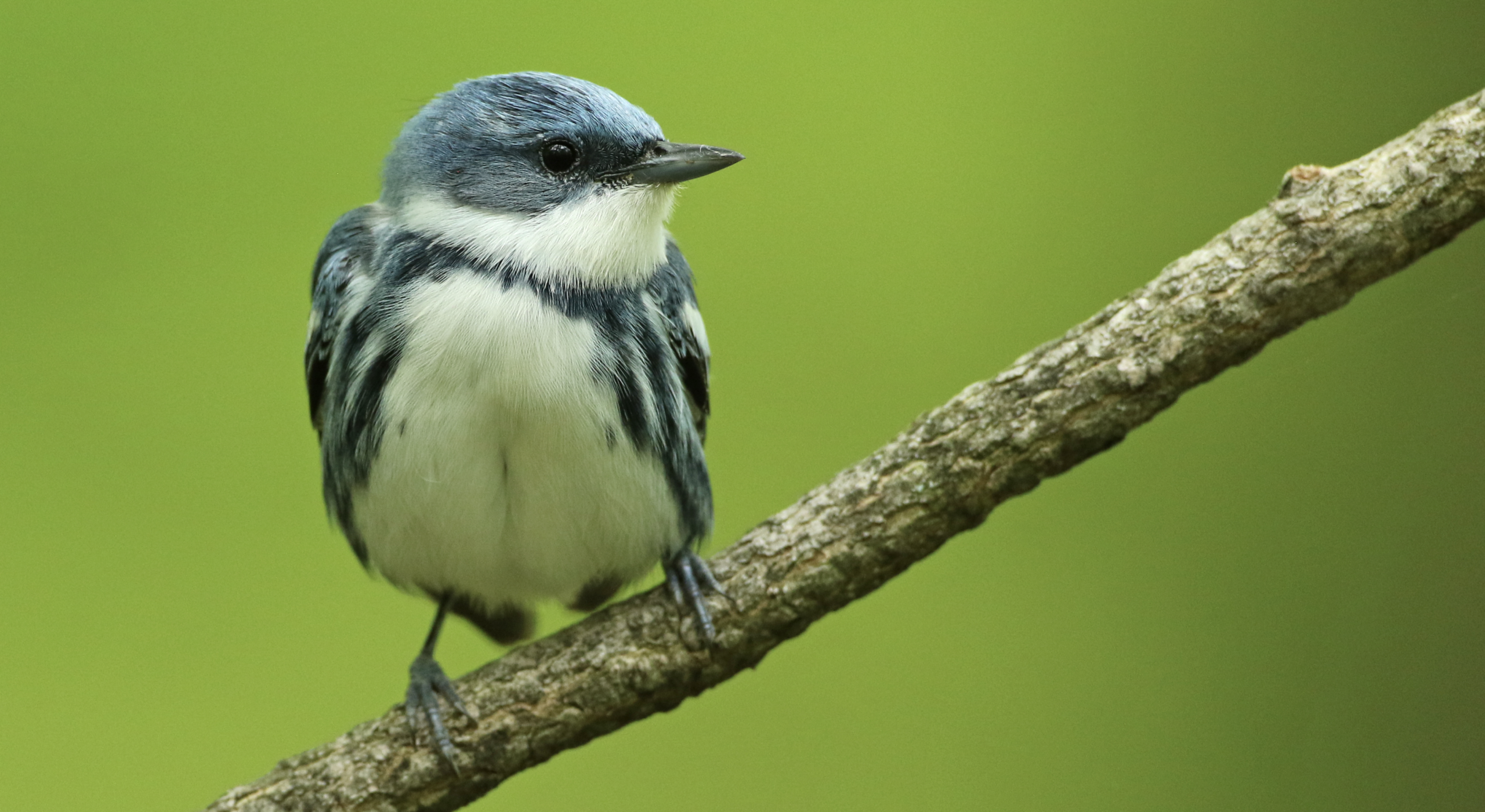
At any given moment, billions of birds are on the move across the Americas crossing forests, wetlands, grasslands, and coastlines in journeys that span entire continents. These migrations connect ecosystems thousands of kilometers apart. What happens in one place can shape outcomes in another.
Until now, understanding those connections on scale has been a major challenge.
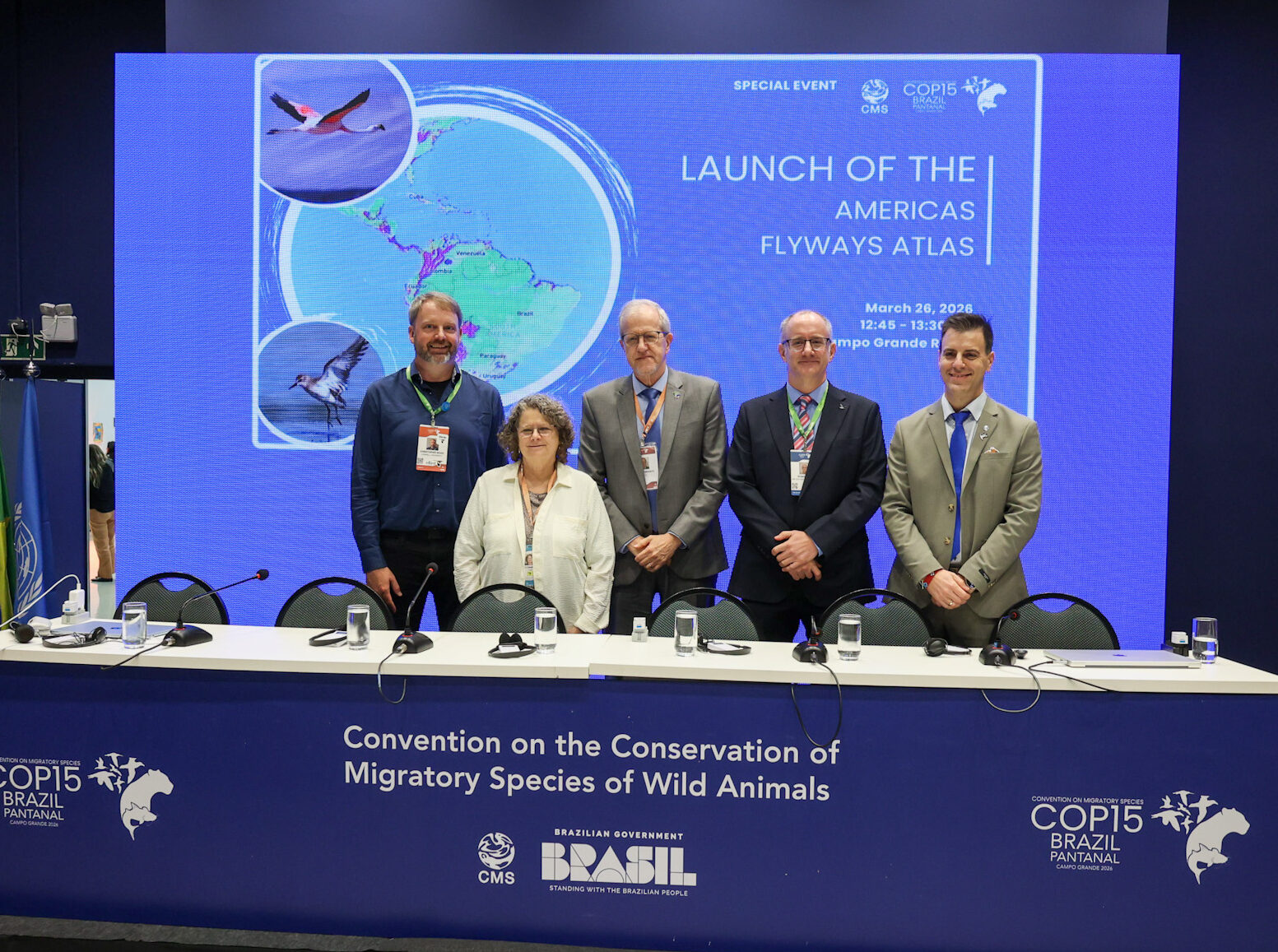
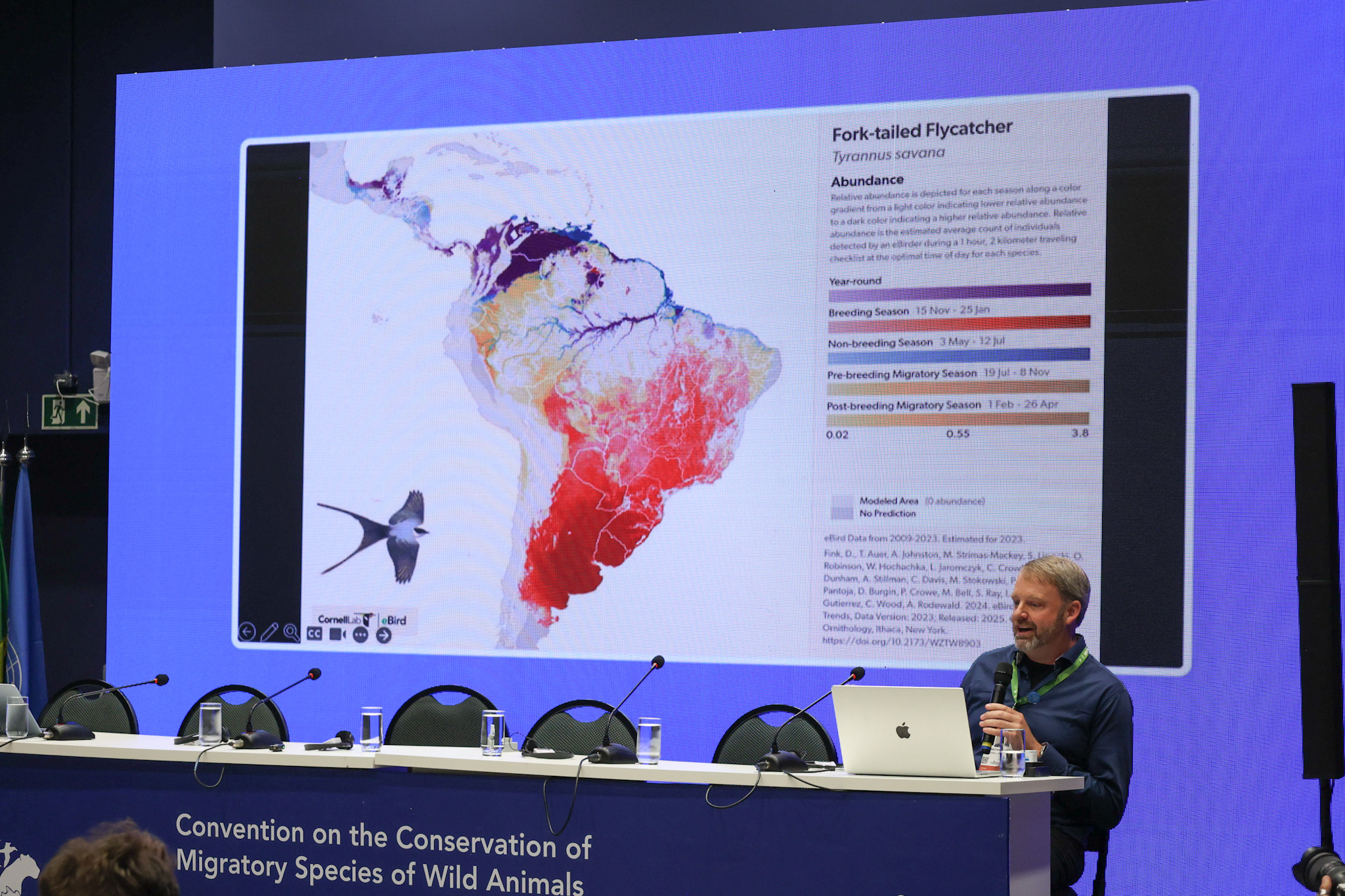
Launched at the Convention on the Conservation of Migratory Species (CMS) COP15 in Brazil, the Americas Flyways Atlas offers a new way forward, transforming decades of data into a tool that helps governments, conservation practitioners, and partners identify where action matters most.
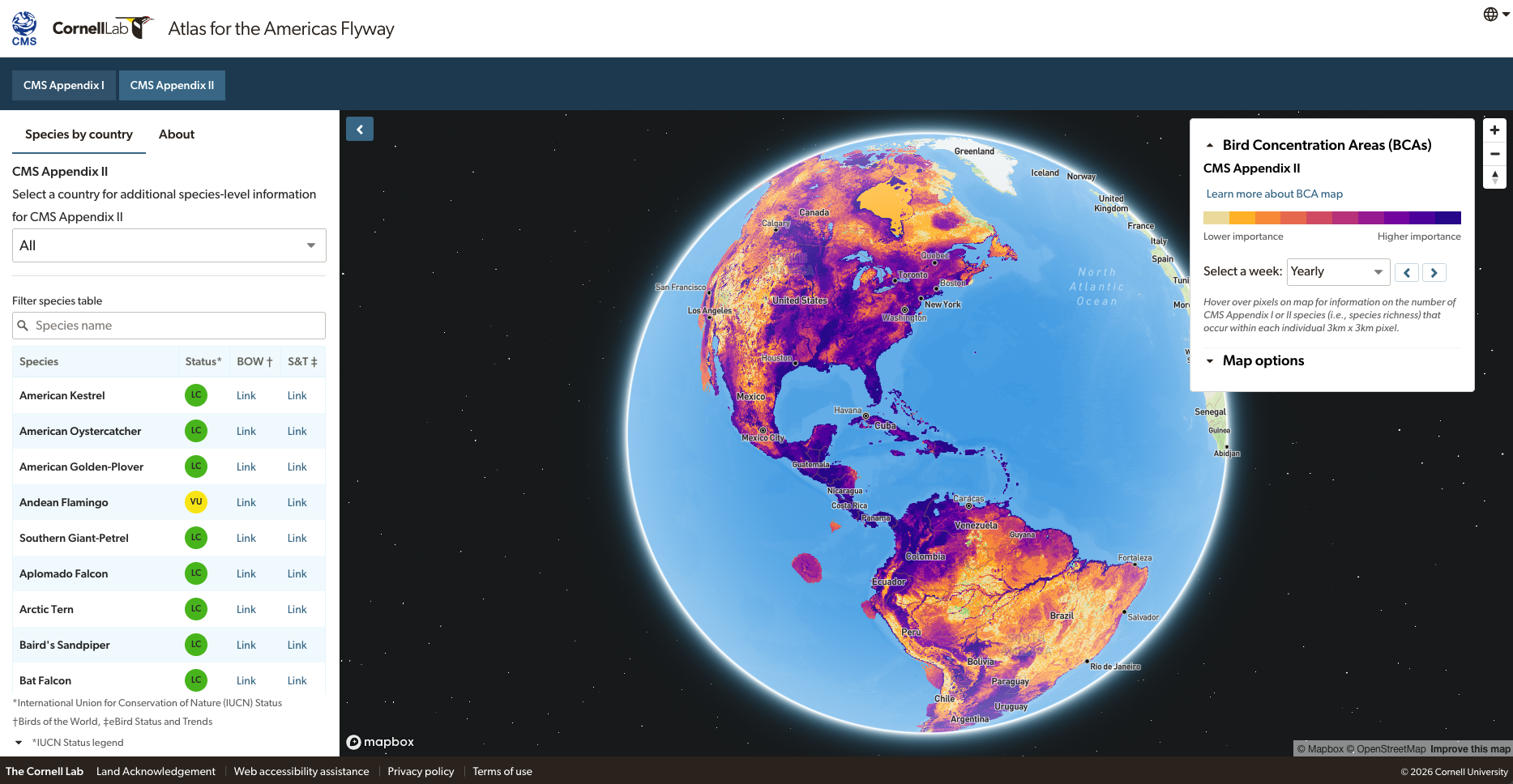
Developed by the Cornell Lab of Ornithology in collaboration with CMS and partners across the hemisphere, the Atlas maps critical breeding, migration, and non-breeding areas for migratory bird species. Drawing on millions of observations contributed through the eBird platform, it identifies “Bird Concentration Areas”—key sites where species gather in large numbers throughout their annual cycles.
At its core, the Atlas makes something abstract—connectivity—visible.
“We talk about connectivity all the time—how migratory species depend on networks of sites across countries,” said Rob Clay, CMS Appointed Scientific Councilor for Birds to CMS. “But while it’seasy to say, it’s much harder to make that concept tangible and actionable. This Atlas helps visualize what connectivity really means.”
Seeing the full journey
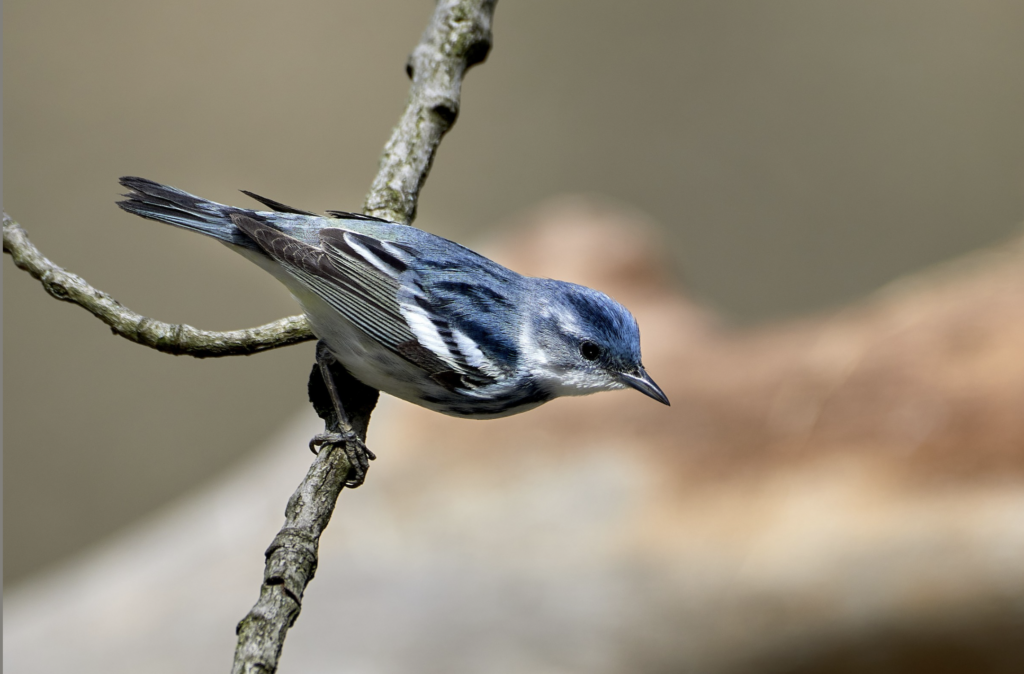
Few species illustrate this better than the Cerulean Warbler (Setophaga cerulea), a small forest songbird weighing just 8.6 grams. Twenty of these birds together would weigh less than a smartphone.
And yet, each year, Cerulean Warblers migrate from the Andes, through Central America, to eastern North America and southeastern Canada—crossing multiple countries and ecosystems along the way.
For the first time, the Atlas allows that journey to be seen in full.
By mapping where species are throughout the year—not just where they are found, but when—the tool reveals the critical habitats that sustain them at each stage of their migration.
“This tool translates hemispheric-scale science into practical guidance that can inform decisions on the ground,” Clay said. “The real value of this Atlas is its ability to bridge global knowledge with local conservation action.”
Among species of migratory birds covered in the Atlas are some of the most iconic and ecologically important migrants of the hemisphere, including:
- Buff-breasted Sandpiper (Calidris subruficollis), a Vulnerable grassland shorebird whose population has suffered rapid declines due to habitat loss.
- Semipalmated Sandpiper (Calidris pusilla), a Near Threatened long‑distance migrant facing sustained but poorly understood declines.
- Cerulean Warbler (Setophaga cerulea), a Near Threatened forest songbird whose breeding habitat continues to shrink and fragment.
- Andean Flamingo (Phoenicoparrus andinus), a Vulnerable high‑altitude species dependent on increasingly threatened Andean wetlands.
- Hudsonian Godwit (Limosa haemastica), a Vulnerable Arctic‑breeding shorebird reliant on a chain of sensitive stopover sites during its remarkable hemispheric migration.
These species exemplify the conservation challenges across the Americas Flyway, covering grasslands, shorelines, tropical forests, and high‑Andean lakes, and reinforce the need for coordinated international action.
A tool for a critical moment
The Atlas arrives at a time of growing concern.
Across the Americas, 622 migratory bird species depend on a fragile chain of habitats spanning 56 countries. Many are in decline, facing mounting pressure from habitat loss, infrastructure, and climate change.
“The Americas support hundreds of migratory bird species, many of which are experiencing significant population declines,” said Amy Fraenkel of the CMS Secretariat. “Protecting them requires shared responsibility, shared data, and coordinated action across entire flyways.”
Brazil—host of COP15—sits at the crossroads of these migrations, making it a fitting place to launch a tool designed to guide conservation at a continental scale.
Powered by people
Millions of birdwatchers, scientists, and community members around the world have contributed observations through eBird, building one of the largest biodiversity datasets ever assembled. Behind the scenes, this work also represents a major scientific and technical effort—combining ecology, statistics, and computer science to analyze vast datasets and generate insights, even in places with limited data.
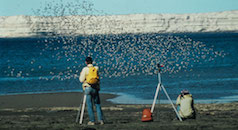
This includes Manomet’s International Shorebird Survey (ISS), where volunteer data collected across the Americas are submitted through a dedicated eBird portal. At Manomet’s headquarters in Massachusetts—where more than 300 bird species have been recorded—observations dating back to 1941 are part of that same growing body of knowledge, contributing to a deeper understanding of migratory birds across the hemisphere.
What you’re seeing in the Atlas is the result of that effort.
That collective effort is what makes the Atlas possible.
“Every year, billions of birds connect ecosystems across the Americas,” said a representative from the Cornell Lab of Ornithology. “What’s remarkable is that millions of people are helping us understand those movements—one observation at a time.”
Citizen science plays a central role, turning individual sightings into actionable knowledge.
People contribute not because they are required to, but because they care about birds, about nature, and about the places they live. Those contributions are now shaping real-world conservation decisions, from identifying priority habitats to informing international policy.
In some regions, they are also creating new opportunities—supporting local livelihoods through birdwatching tourism and community-based conservation initiatives.
From data to decisions
Ultimately, the Americas Flyways Atlas is about making science usable.
It brings together ecology, data science, and global collaboration to answer a simple but urgent question: where should we act?
By turning millions of data points into clear, accessible insights, the Atlas helps bridge the gap between knowledge and action—connecting global science with local decisions.
“If we want to move from conversation to action, we need tools that communicate clearly and convincingly,” Clay said.
With migratory birds facing increasing threats across the hemisphere, that clarity has never been more important.